

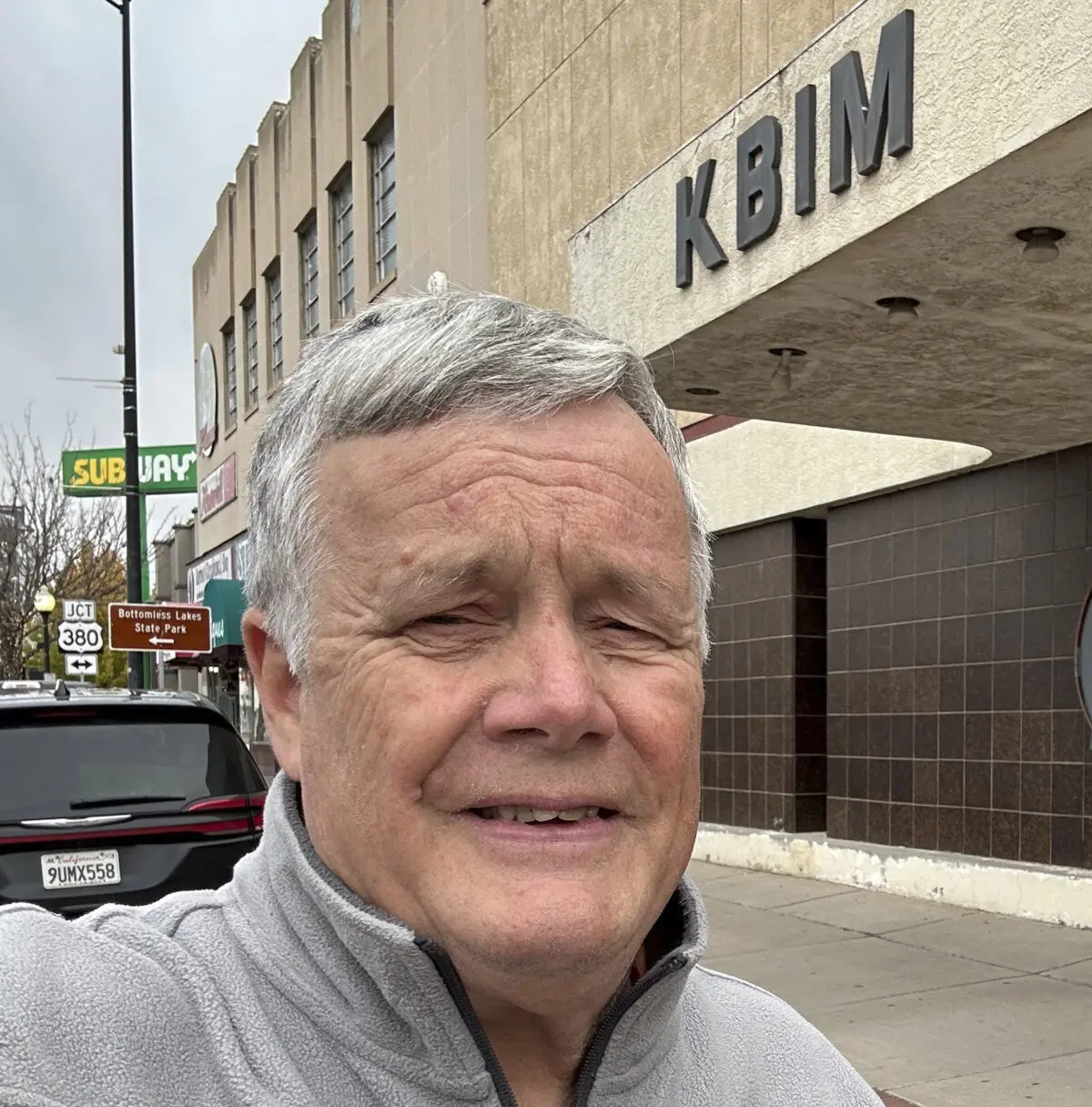
By Roger Riley — Memories of a Roswell TV reporter, who graduated from Eastern New Mexico University in 1977.
Getting that first job in journalism is a big step for any would-be reporter. It was no different for me. Graduating from Eastern New Mexico University in May of 1977, I was ready to return to my home state of Iowa and use my wonderful talents as a broadcaster.
There was just one problem: I could not even get an interview in places like Cedar Rapids, Sioux City, Des Moines or even Mason City. I ended up as a reporter with the Quay County Sun in Tucumcari. Not long after I began there, the call came for an interview at KBIM-TV in Roswell. I landed that job doing weekend weather and reporting. It was hard to leave Tucumcari after a very short stint, but this was my big break.
The first day on the job, KBIM-TV Roswell News Director Dave Brown gave me a still camera and told me to go shoot some photos of the local county fair. I thought it was strange taking stills for TV news. But I guess I needed to be checked out on the process of shooting film with sound for TV.
My hire at KBIM-TV came in September of 1977. The fire burned down the KBIM-TV building in May. News Director Dave Brown told me that when they went to fill the position, mine was the only resume they had after the fire.
Due to the fire, we had a brand new CP-16 (Cinema Products camera), a sound-on-film camera, meaning that it recorded sound on a magnetic tape alongside the film visual image.
The sound and film were not synced at the same place on the film, so you had to understand how to edit that with a splicer so it would be in sync when it aired.
The station had what were called “film chains” or projectors hooked-to-tv cameras. When you had two of those, you could air an interview along with “b-roll” over that with another reel rolling during the a–roll interview.
This was the first wave of many, which I would need to learn over my 50-year career in broadcasting. After the film came ENG (electronic news gathering), which was tape that was edited from machine to machine. Then came non-linear editing on a computer in 1996. That was an amazing upgrade. Digital video came into its own when we all got high-definition TV in 2010. For the first time, video and audio could be sent over the internet or by cellphone.
I still produce news stories for my longtime employer WHO-TV, using a mobile phone. I retired from working full-time in May of 2025. With that phone I can shoot and edit and send completed stories back to the station, no matter where I might be located.
One of the major stories I covered was the American Agriculture Movement protest in Washington, DC, in 1979. Farmers tied up traffic with tractorcade protests. The message got through, and some legislative help was approved for farmers in this country.
My first days at KBIM-TV were in a former department store right off the alley where the new station would be housed. It was a big open area. The news department was on the west wall of the store, to the right next to some creaky wooden stairs, which went upstairs to where KBIM Radio was housed. In the northwest corner of the store, the management and the sales department were located.
A new control room had been constructed inside the store building. It was temperature controlled with a small anchor desk and a window into the control room. Inside the control room were tape machines and the switching and audio boards.
One of the most challenging things about working at KBIM-TV in those days was processing film. Some would refer to this process of developing the film footage as “running it through the soup.” I can’t recall the mixture of chemicals, but we had to get the film developed on every story. Sometimes you could adjust the brightness of the images by altering the process temperature.
We also had to maintain the processor. That meant tearing all the reels apart and cleaning them with a toothbrush. The bleach would stain my fingers for days.
Working in TV also meant working holidays and weekends. I remember working one Christmas Eve. The station had relocated to 214 North Main St. The processor was still located in the department store across the back alley. We had kind of a garage door opening into the parking lot there. As the film was running, I walked out of the building to see a million stars in the skies over Roswell. That was a special blessing on Christmas Eve, and I didn’t mind that I had to work at something I loved.
When the new building was up and running, the film processing was moved and had a nice space next to the newsroom, where they could run the film.
One of my jobs was to do the weekend weather. I would get the weather forecasts off the wire machine. In the new studio we had big magnetic maps. I would make my own cold front out of magnets and give the forecast temps for U.S. and New Mexico cities. One time I recorded a film of a local tractor pull-down around Dexter and put my forecast over that film video; I thought it was pretty advanced. The film showed a dusty tractor pull, so I could comment on how dry it was there.
Life at KBIM also started with a tradition, which I’ve not done since: the morning coffee break. MI and a couple of engineers would wander down the alley to a place called The Capitol Cafe. On my last visit, that place was still there, now called Martin’s Capitol Cafe. The inside did not look at all the same. That was a good memory to relive of my first TV job in Roswell.
This column is an effort to remember those who served the community on KBIM-TV and those who watched the local news and programming. Also, there is a Facebook site; search: KBIM-TV, New Mexico Memories.