

By Rodd Cayton
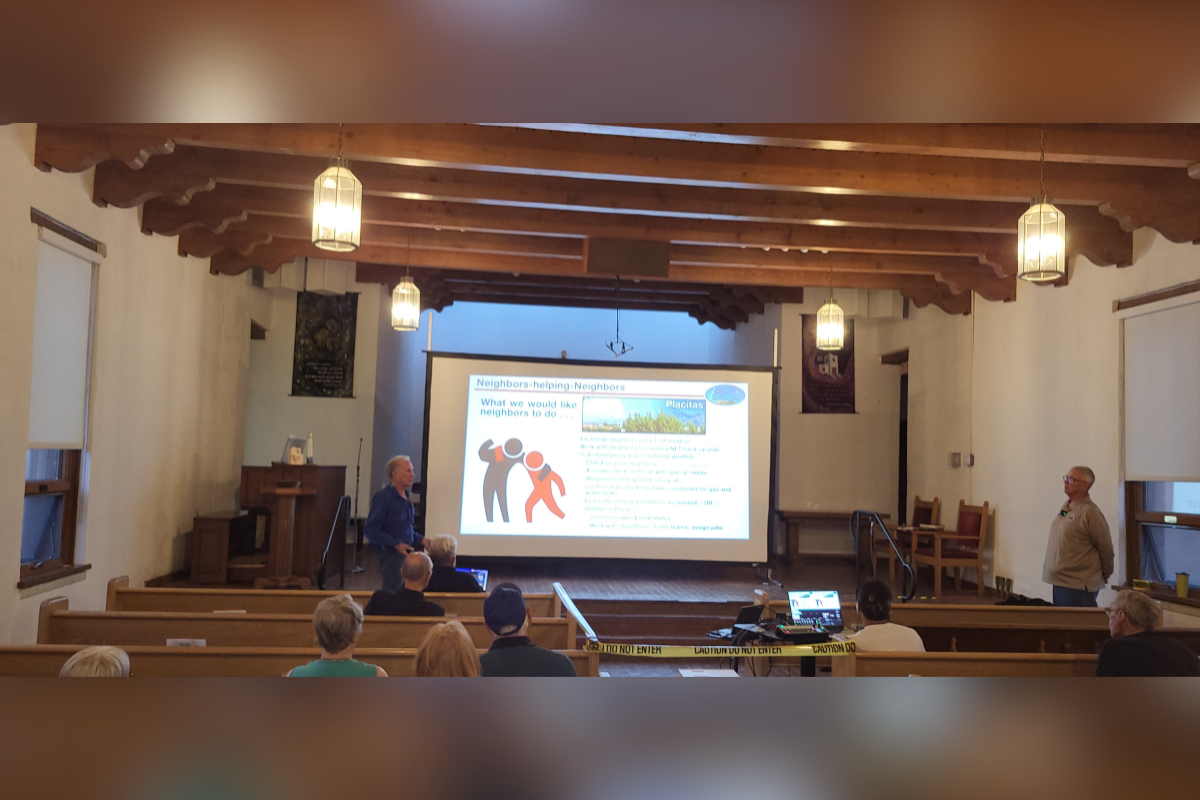
Placitas residents needing to know how to shelter in pace is not a matter of “if,” but a matter of “when,” Sandoval County Emergency Manager Dan Heerding said Tuesday night.
“Do some homework,” he told those gathering at a community briefing on sheltering in place.”Do some reading. Think about all the emergencies that could happen.”
Heerding and Allen Saville of the Placitas Resilience & Emergency Preparedness Alliance (PREP) spoke of being physically and mentally prepared for possibly without access to electricity or gas.
Physical preparation, the pair said, is about having supplies and equipment on hand for use in that crisis. Saville said food, water and alternate sources of light and power are important. The mental side, they said, involves being aware of what to do, including contingency plans for various scenarios, backing up important documents in advance and an understanding of how vital equipment works.
Saville’s slideshow included a graphic of a child playing with a yoyo. “‘Yoyo’ stands for ‘You’re on your own,’” he said, adding that a significant incident will probably make emergency responders unavailable for some time. “It’s not that the fire department and the other emergency services don’t care about you, but in some situations, they are spread so thin at the beginning of an incident that they can’t get to you right away.”
Possible situations that might necessitate a shelter-in-place order include wildfires, floods, gas leaks or a mass-casualty incident. Saville said that in the wake of lawsuits across the West, electric utilities are pre-emptively shutting off power in times of high winds, and could inspect every power line before turning it back on. “A power outage is sort of a shelter-in-place all by itself, whether there’s an emergency to go along with it or not,” he said. Saville said many residents’ access to gas and water will be jeopardized if a power outage is prolonged. He and Heerding suggested residents look into items such as solar generators or jump starters, particularly if someone in the household has an oxygen generator or CPAP machine. Some of those devices, he said, have ports that enable charging of mobile devices.
Other necessities include adequate food, water medications and hygiene supplies for everyone in the household (including pets) and a smartphone, which Saville said is probably the most valuable piece of emergency equipment. Heerding said each household should have an emergency plan that spells out where members will reunite afterward and recommended setting up networks of neighbors who can look out for one another.
The pair said residents should know how to use the items in their first-aid kits and other supplies, and ensure they have the right tools to turn out the gas or water at their homes if necessary. They also recommended some CPR training and learning about using a tourniquet. “The stigma of (the) tourniquet is gone because of the Gulf War,” Heerding said. “Learn how to use them. You’re gonna you’re gonna hurt somebody putting it on because it’s gonna be that tight.
“If you put it on properly, they’re not going to be happy,” Saville added. “But you’re going to save their life.”
The presentation began with Saville showing attendees a map showing emergency escape routes of Las Placitas Presbyterian Church, which hosted the briefing. Saville and Heerding also encouraged visitors to enroll in Sandoval County Alerts and Notifications (SCAN), which sends out emergency messages in a variety of ways.
PREP’s objective is to cultivate emergency preparedness in the Placitas area. The organization plans to host about four community briefings a year on related topics.