
Columnist Sasha Abramsky in The Paper. — When I was sixteen, I traveled with a friend from England to the East Coast of the United States. Relying on the hospitality of relatives and family friends, we dotted up and down the coasts, and a few places in between, in two months exploring this vast Country.
We started in Niantic, Conn., staying with my great uncle and aunt for a couple weeks. I remember my joy at the warmth of the ocean and the spectacle of a summer-crowded sandy beach. I remember the huge cold cut sandwiches my great uncle and aunt would make for us each day before we headed off for a day of sun-and-fun—something about the sheer scale of these creations to my teenage mind somehow symbolized the endless possibilities of the United States. And, perhaps most vividly, I remember the enormous blueberry muffins that we could buy, for a couple of dollars, at one of the little beachfront cafes. By no stretch of the imagination did we have muffins anything like these in England. They were, quite simply, decadence personified.
That summer was the first time I ever visited New York—a city I would later live in for a decade as I built my journalism career, my social circles, my family, throughout my 20s. I was blown away by the place, by the carnival of life: the mad energy of Greenwich Village, the intense subcultures of the Lower East Side, the three-card monte hustlers and breakdancers in the riverfront parks, the street vendors in Chinatown, the world-class museums, the roller-bladers in Central Park, the seedy, scary, yet somewhat exhilarating transit hubs at the Port Authority and George Washington Bridge.
Everything about the city screamed newness and freshness and, yes, danger and edge, to me. Yet beyond the spectacle, at the same time even as a somewhat solipsistic teenager I could see that its streets and neighborhoods oozed history. There was a narrative being written here that could be written nowhere else on earth.
The whole world was concentrated in those overcrowded streets, and in the way different cultures and languages and cuisines and music blended something entirely wondrous emerged. One minute you were in China, the next in Italy, the next in the Dominican Republic, the next in Puerto Rico, the next in Eastern Europe, the next in
Korea, the next in Mexico. You could smell all the different foods, hear all the different dance rhythms. Everything was right there, in your face, ready to take you somewhere new—if only you had the confidence to let it. Who in their right mind could or would oppose such a polyglot vision of humanity?
My mom’s parents—her dad a violinist, her mother a modern dancer—had lived in New York in the early days of the Great Depression, before decamping for Hollywood. My mother had grown up in LA before moving to England in the 1960s. When I visited my grandparents as a kid, they told me stories of the city way-back-when. They also told me of their own parents’ migration experiences from the Jewish shtetls of the late Russian empire. One set of my great grandparents had ended up in Connecticut, another in Pittsburgh. Other relatives had lived on New York’s Lower East Side. In later generations, some of the family could be found in New Jersey, in Chicago, in Detroit, and, by the dozens, in California.
I don’t think there’s anything particularly unique about that story. It’s what the United States, at its best, is: a place where people have, for generations, come to reinvent themselves—a sanctuary in a world of poverty, of violence, of truncated hopes and opportunities.
It’s pretty much a truism that whoever you talk to in this land (and over the 30-plus years that I have been a journalist, I have been lucky enough to talk to thousands upon thousands of people in all corners of the country) they can tell you an immigration story—a story of how and why and where and when their ancestors decided to uproot themselves and seek out something better. Or they can introduce you to the flipside of that dream—they can tell you the nightmare: how their families were kidnapped from their land, bundled into slave vessels and subjected to the Middle Passage; or how their families were driven off their ancestral territories by White men determined to destroy the Native communities that had lived here for eons, and to stamp their own dominance over the mountains and rivers and valleys and deserts, over the forests and seafronts, the prairies and the plateau-lands that, collectively, make America America.
This country has always been a patois, a place where dream and nightmare, creativity and conformity, intermingle. It is whimsical and beautiful and garish and violent all at the same time. Yes, it’s the country of Emma Lazarus’s timeless homage to the generosity of the human spirit, etched forever on the base of the Statue of Liberty, and it’s the country of Martin Luther King and Sojourner Truth, of John Steinbeck, Louis Armstrong, Woody Guthrie, Bob Dylan, Harvey Milk, Marilyn Monroe, Aretha Franklin and Groucho Marx. It is the land that gave the world jazz and tater tots, skyscrapers and the Old Fashioned cocktail. But it’s also the place from which emerged George Wallace and the Ku Klux Klan, lynch mobs and Know-Nothing brigades fearful of any and all change, fugitive slave hunters and out-of-control ICE agents, the red-baiting senator Joe McCarthy and the ruthless J. Edgar Hoover, chain gangs and mass killers, and, most recently, Donald Trump and Pete Hegseth and Stephen Miller and Elon Musk and the rest of the ragtag band of two-bit hoodlums, grifters, racists and sadists currently running the show.
Happy Birthday to ME (on you)
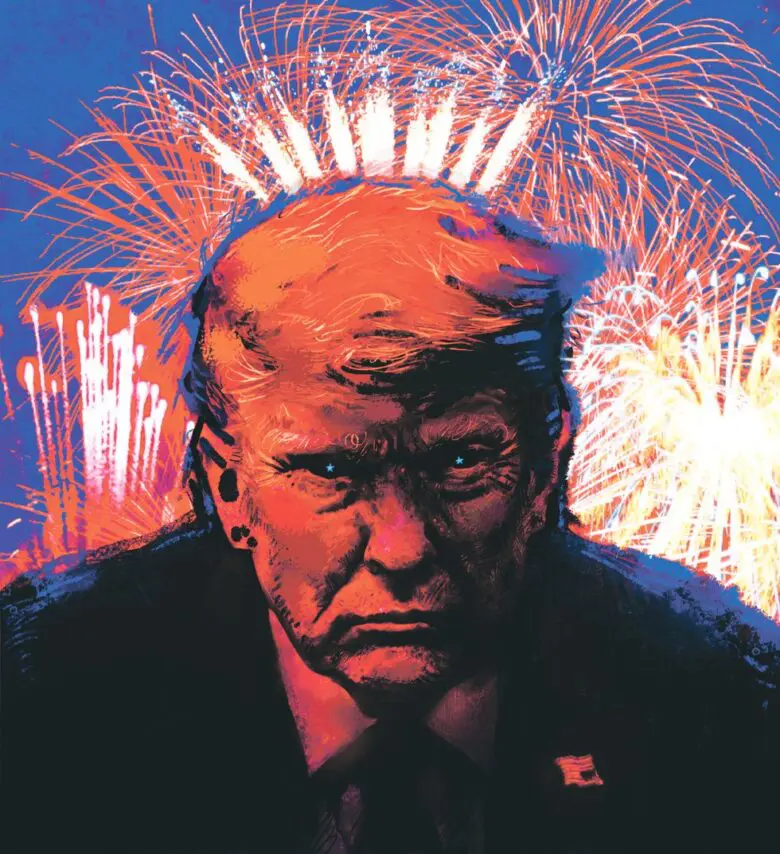
In mid-June, Trump threw a garish, crude, 80th birthday bash for himself and a quarter-millennium celebration for the United States. He chose not to highlight the soaring aspirations of America, nor to celebrate the majestic diversity and the magnificent cultural achievements of this continental space, but instead to construct a giant UFC arena on the hallowed White House lawn and to treat America to a gladiatorial spectacle of grown men kicking and beating and gouging the shit out of each other in a testosterone-fueled frenzy.
This was Trump’s Idiocracy-vision of what the United States was, is, and will be. And it was entirely in keeping with the ghastly spectacle that has convulsed this country since Trump captured the political spotlight in 2015.
The MAGA leader has spent much of the past decade deliberately trying to put all of the glories of American culture and American diversity into a memory hole. His authoritarian project, which has been turbocharged in the second incarnation of his presidency, isn’t just about accruing political power and reaping the financial benefits—though he is doing that in spades; rather it is about fundamentally rewriting the American story in a way that erases those who aren’t white, aren’t Christian, aren’t straight. It’s about replacing the concept of democracy with the concept of Strong Man rule, and, absurdly, about denigrating the notion of universal rights and liberties as somehow “woke” and therefore illegitimate. Increasingly, I have come to think that it is, at its core, about unravelling the Enlightenment and replacing a world of rationalism and science and the language of political universalism with something much darker and more dangerous—something, ultimately, much more primitive.
In court recently, a Department of Justice lawyer argued that if Trump chose to remove the Statue of Liberty from New York harbor, there wasn’t a damn thing the courts, or anyone else, could do to stop him. It was pitched simply as a hypothetical, a way to drive home the point that the Supreme Court has largely sanctified the un-American idea that the president lives outside of, and above, the rule of law. With not even a semblance of public participation and of due process, Trump has already bulldozed half of the White House to make way for a
monstrosity of a ballroom; has paved over the fabled Rose Garden; and has remade most of the surviving interior of the building as a gold-spangled monstrosity that looks more like Louis XIV’s Versailles than the People’s House. He has draped his snarling visage from numerous government buildings; authorized his private pool cleaner to mess around (to comically ill-effect) with the reflecting pool on the mall; and is looking to start work on a 250 feet high triumphal arch—all without Congressional input. In the DoJ’s telling, the president can do all of this and more—much more, right down to destroying the Statue of Liberty should he so desire—because the Supreme Court, in its infinite wisdom, has ruled that the president can pretty much do anything.
There was something utterly unnerving about the DoJ honing in on this example in court. For given Trump’s antipathy to everything represented by Lady Liberty and by Lazarus’s great poem that accompanies her, it was hard to see this as anything other than a not-too-veiled threat against the dream embodied by Bartholdi’s extraordinary statue. Why not, one day, dynamite Lady Liberty and replace her with a soaring gold sculpture of either Trump himself or one of his ultimate fighting avatars? After all, that’s the America Trump wants the world to celebrate and to fear.
This is a warped, shriveled, gangster-vision of the United States that I cannot even begin to imagine partying for. But despite Trump’s Louis XIV notion that l’etat, c’est moi – “the state, it is me”—the United States can never be reduced to such a limited vision. Even in an age of finely tuned propaganda outpourings, a critical mass of Americans will continue to understand that Trump and the US are not synonymous. No man owns the rights to America, and no-one owns the script about how 330 million Americans celebrate their country’s milestone birthday.
As July 4 th approaches, here’s what and who I will drink a toast to: The vast wells of courage and dignity shown by the non-violent anti-ICE protestors who came out by the tens of thousands in Minneapolis this past winter. The immigrant rights attorneys who have worked so tirelessly to push back against Trump’s endless efforts to make America white again. The artists brave enough to refuse to perform in a Kennedy Center illegally renamed after Donald Trump. The men and women in the Deep South working tirelessly to push back against recent efforts, turbocharged by the Supreme Court and by Southern GOP governors, to eradicate majority-Black political districts. The street performers in Portland who dressed up as frogs and dinosaurs and unicorns in a rolling theater-of-the-absurd effort against ICE. The honorable attorneys and scientists and military officials who have resigned from the federal government rather than partake in clearly illegal or unethical actions ordered by the Trump administration. The teachers who continue to teach children the value of inclusivity and kindness and empathy. The community activists who still provide food and medical services to impoverished people increasingly being deprived of basic government services by a regime that believes empathy equates to weakness.
These are the heroes of our moment. For they are the people who represent all that is best in the United States’s 250-year story, who are willing to go to bat for ideals that, in ways large and small, have, at its best, made this country exceptional. And, when the Trump fever-dream finally breaks, these are the decent, honorable, hard-working people who will pick up the pieces and help shape the next quarter millennium in the American story.