



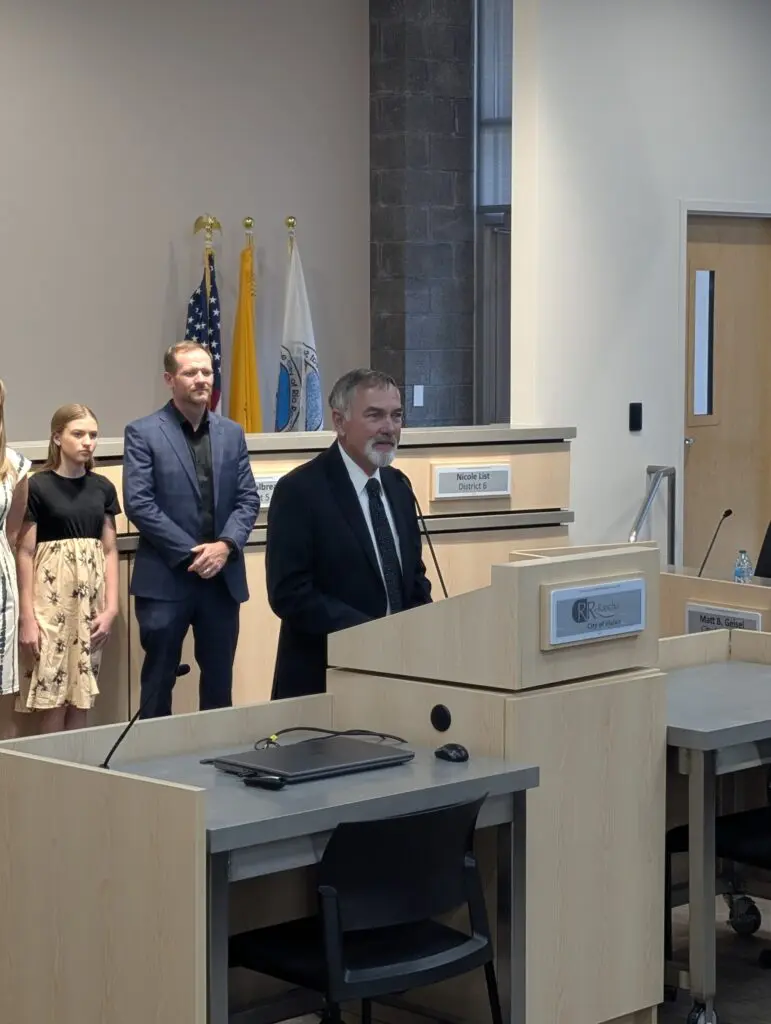
Paul Wymer’s first full day as mayor of Rio Rancho didn’t start with a honeymoon. It started with a budget.
Sworn in April 30, Wymer joined the governing body at 9 a.m. on May 1 for a special work session to review the city’s recommended fiscal year 2027 budget and a five-year capital improvement plan — part of the mandated annual process of approving a spending plan for the upcoming fiscal year, July 1, 2026 to June 30, 2027. Both proposals were introduced by City Manager Matt Geisel on April 15.
Wymer asked questions throughout but let council members and staff do most of the talking.
The budget: structurally balanced, growing
The recommended budget totals $452.3 million in sources and uses across all funds, according to the city manager’s transmittal letter. The city’s two primary operating funds make up 55% of that total: the General Fund at $169.9 million and the Utility Operating Fund at $78.3 million. The governing body also discussed $942.9 million in infrastructure projects planned from 2027 to 2031.
Geisel and Deputy City Manager Peter Wells described the budget as structurally balanced, with recurring revenues projected to exceed recurring expenditures throughout a five-year planning period.
The recommended budget funds 21 new positions, 13 of them in public safety. Nine of those are firefighters slated to staff the new Fire Station 8 — which broke ground May 4 and is expected to take 15 months to complete — along with two police officers and two real-time crime center operators. All city employees would receive a 5% compensation increase beginning July 13, the first full pay period of the new fiscal year, at an estimated recurring cost of $2.6 million to the general fund.

The fight over SEA
A topic that generated protracted discussion was funding for the Sandoval Economic Alliance (SEA), a private nonprofit economic development corporation. The FY27 recommended budget includes $75,000 for a services contract with SEA that has been in place for several years.
District 3 Councilor Bob Tyler pushed to cut that to $55,000 and redirect the remaining $20,000 to the Rio Rancho Regional Chamber of Commerce — an organization the city does not currently fund.
“It’s no secret I’m not a big fan of SEA — I think it’s money that we can spend in other places. Just like we’re buying business software to track and do what SEA should be doing — or should have done,” Tyler said. “I think all we’re doing is we’re just giving them money to pay their bills.”
Tyler argued the chamber has been more successful in fostering economic development, pointing to 251 events and more than 40 ribbon cuttings each year in 2024 and 2025.
Other councilors weren’t ready to go that far. Councilor Jeremy Lenentine argued the chamber and SEA serve fundamentally different roles — SEA focused on business recruitment and attraction, the chamber operating in the post-launch space — and said the city shouldn’t fund the chamber from the municipal budget at all, cautioning that ribbon-cutting visibility doesn’t equal business recruitment. Tyler called for accountability across the board.
“If we’re going to hold one group accountable for a set of metrics,” Tyler said, “then that set of metrics needs to be accountable to both groups.”
Geisel, who sits on SEA’s board of directors, defended the organization’s work. “There’s been good positive work in that area,” he said, citing three contract focus areas — business retention and expansion, site readiness, and microeconomic gardening for small entrepreneurs — and noting that SEA provides quarterly reports tied to its quarterly payments. He proposed a deeper economic development presentation at an upcoming budget hearing or the June work session where SEA could present directly to the governing body.

Other notable discussions
Beyond the SEA debate, councilors surfaced several other issues during the line-by-line review:
Fire overtime: Lenentine asked city staff about the proposed compensation and overtime pay increase for firefighters. “Are we understaffed there?” Lenentine asked. “Do we need to hire, or is this just more of a volatile allotment?” Budget Manager Don Martinez said the overtime jump reflects a shift to budgeting based on actual historical spending rather than placeholder figures. “We’re trying to align it with reality,” Martinez told Lenentine. Fire Chief James Wenzel said the overtime budget covers minimum staffing, paid time off, training, and special events — the department ran 62 special events in 2025. When Lenentine asked whether those events were worth asking off-duty firefighters to work, Wenzel called community engagement “huge,” saying it gives residents a chance to interact with the department outside of emergencies. On staffing levels, Wenzel said the department is “good to go,” with Fire Station 8 set to add more employees once it opens.
Police compensation: The 5% raise built into the recommended budget does not cover a separate compensation agreement currently under negotiation with the city’s police officers’ union. That adjustment will come forward as a budget amendment on May 28, at an estimated cost of $1.4 million.
Animal Resource Center: The FY27 budget includes $1.2 million for kennel improvements at the Animal Resource Center.
Workers’ compensation: Premium increases across all departments reflect a statewide rate hike from the New Mexico State Insurance Fund — not an increase in city claims — according to city staff.
District 4 vacancy: Wymer’s move from the District 4 council seat to the mayor’s office triggered an appointment process the city has never used in its 45-year history, where a former councilor appoints his own replacement. Under Section 2.06.B of the Rio Rancho City Charter, Wymer has 60 days to appoint a qualified successor to his former seat, subject to confirmation by the full governing body. The appointed successor would serve through the next regular municipal election, expected in 2028. Residents of District 4 — which covers a large swath of south-central and southeastern Rio Rancho, roughly bounded by Unser Blvd SE to the west, Abrazo Road to the north, Southern Blvd SE to the south, and Pat D’Arco Highway to the east — have until noon on May 26 to apply. The seat carries an annual salary of $22,113.84.
Rio Rancho FY27 Budget: What’s Next
Thursday’s work session did not include public comment. Residents can weigh in at the governing body’s regular meetings on May 14 and May 28, both at 6 p.m. at City Hall. The governing body is expected to adopt the budget and capital program on May 28 before submitting it to the state by May 31. A final budget, accounting for minor adjustments from the close of FY26, will be approved in July.
- Public comment meetings: May 14 and May 28, 6 p.m., City Hall Council Chambers
- Budget and capital program vote: May 28
- State submission deadline: May 31
- Final adopted budget: July governing body meeting
- View the budget: rrnm.gov/5053/FY-27-Recommended-Budget
- Stream past meetings: rrnm.gov/2303/Watch-and-Download-City-Meetings
District 4 Council Seat — Apply Now
- Deadline: Noon, Tuesday, May 26, 2026
- Apply online: rrnm.gov/D4vacancy
- Confirm your district: rrnm.gov/212/City-Council-Districts
- Salary: $22,113.84/year