

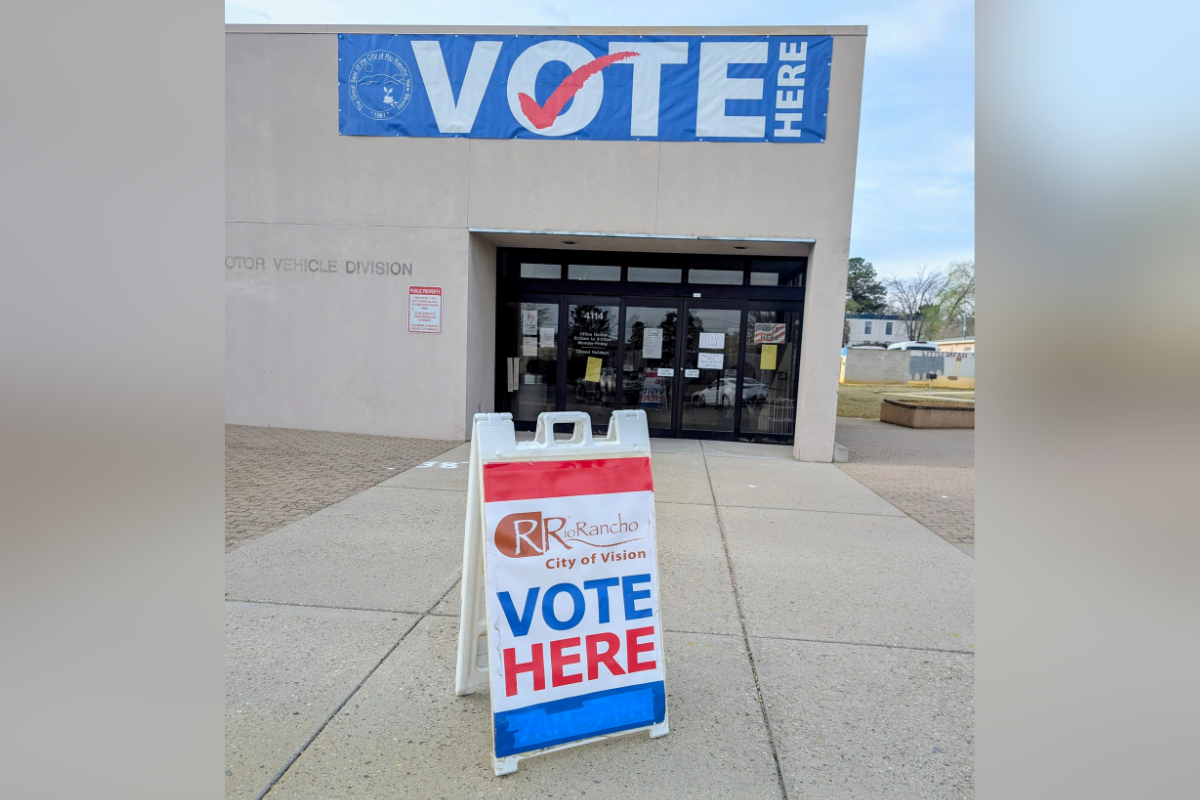
Rio Rancho mayoral runoff draws highest turnout in city history
Tuesday's mayoral runoff set a new Rio Rancho turnout record, with nearly 20% of eligible voters casting ballots — the most votes ever recorded in a city municipal election.
Rio Rancho voters turned out in record numbers Tuesday for the city’s mayoral runoff, with nearly 20% of eligible voters casting ballots — the highest turnout ever recorded for a runoff election in the city’s history.
Unofficial results from the New Mexico Secretary of State’s office show 16,492 ballots cast out of 83,751 registered voters — the most votes ever recorded in a Rio Rancho municipal election, according to city clerk data going back to 2000. That surpassed the March 3 election, which had set the previous record at 13,814 votes, and more than doubled the 6,559 ballots cast in the mayoral runoff in 2014. Paul Wymer defeated Alexandria Piland, 10,394 votes (63%) to 6,096 (37%), to become the city’s next mayor.
The March 3 election, which featured a contested council race and a six-candidate field for mayor, also outperformed recent history, drawing 13,814 voters — a 16.96% turnout rate — making it the highest-turnout regular municipal election since 2008. Combined, the two-election cycle represents the most sustained voter engagement Rio Rancho has seen in nearly two decades.
Rio Rancho’s election history tells a story of uneven but rising civic participation. Mayoral races consistently drive the highest turnout — the 2008 election peaked at 19.94% before Tuesday’s runoff eclipsed it — while bond elections and off-cycle specials have historically struggled to draw voters. The 2010 runoff was the low point on record, with just 2.28% of registered voters casting ballots (1,100 votes). Special elections have fared only marginally better: a 2009 bond measure drew 3.66% and a 2011 bond measure 6.16%, suggesting Rio Rancho voters engage most when a candidate race is on the ballot. The 2016 runoff (7.45%) and the 2024 runoff (6.54%) showed that even contested races can underperform when voter fatigue sets in after a primary. By contrast, the three mayoral cycles that generated the strongest turnout — 2008, 2022 and now 2026 — each featured competitive, high-profile races that drew significant campaign spending and media attention. Tuesday’s 19.69% runoff turnout breaks that ceiling entirely, driven in part by a six-candidate March election that kept the race in public view for weeks before the head-to-head matchup.
Tuesday’s record also reflects how dramatically civic participation has grown alongside the city itself. In 2000, Rio Rancho had just 12,261 registered voters and fewer than 700 people showed up — a 5.66% turnout rate. By 2026, the voter rolls had grown nearly sevenfold to more than 83,000, and raw vote totals have climbed in step: the 16,492 ballots cast Tuesday represent more than 23 times the votes counted in the 2000 municipal election. Even in lower-engagement cycles — the 2020 regular election drew just 8.98%, the 2024 runoff a mere 6.54% — the absolute number of voters participating has grown steadily as Rio Rancho has become one of New Mexico’s largest cities.
More details:
- The previous runoff percentage record of 15.08% was set April 15, 2008 — exactly 18 years before Tuesday’s election.
- The 2022 mayoral runoff, the most recent comparable race, drew just 9.06% turnout (1,135 votes).
- Rio Rancho’s voter rolls have grown from roughly 12,000 registered voters in 2000 to more than 83,000 today.
- Results remain unofficial pending canvass by the Sandoval County canvassing board on April 22.