

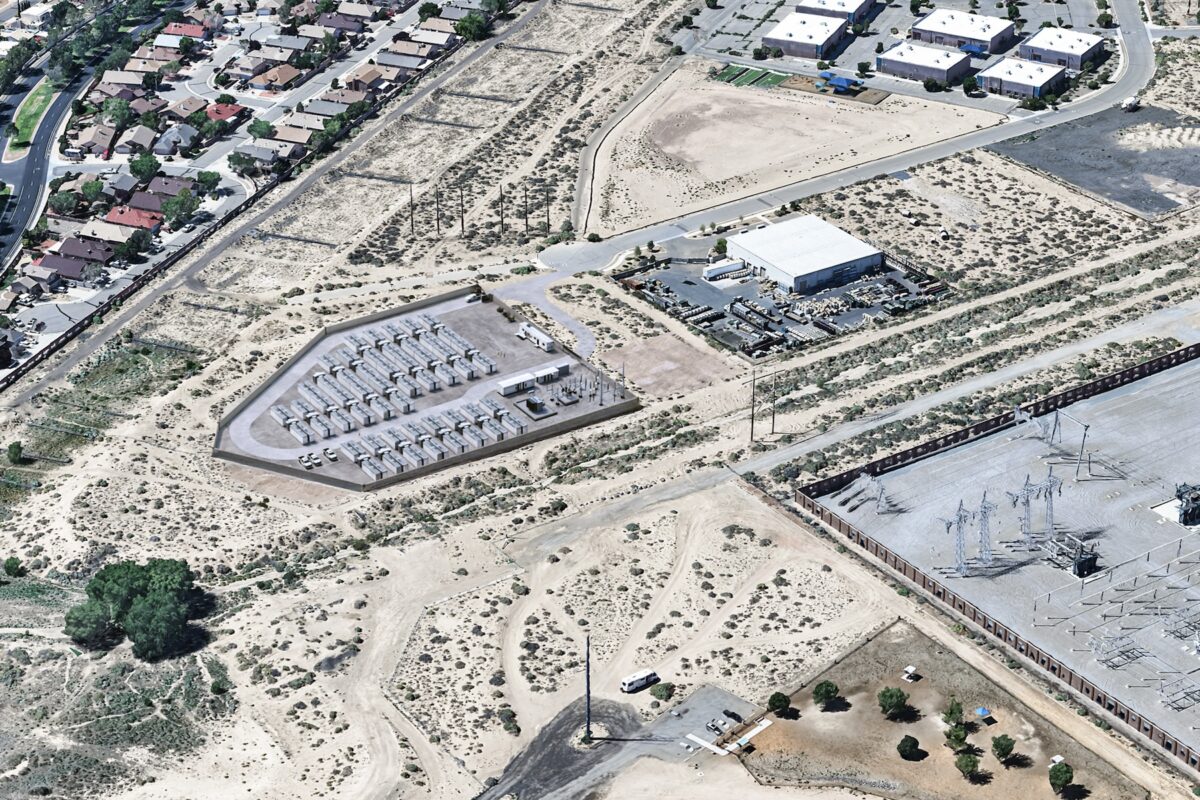

By Jesse Jones, The Paper. — With an uncertain future for power rates and unreliable power grids, Bernalillo County residents may see more stable electricity rates and a stronger power grid, following the approval of a $175 million battery storage project on Albuquerque’s Westside.

Bernalillo County commissioners approved an industrial revenue bond, 4-1, March 11, for the Oso Negro Battery Storage project, which is being developed and owned by Texas-based Plus Power, a company specializing in utility-scale energy storage. The standalone battery energy storage facility will be located in the Ladera Business Park within PNM’s West Mesa Substation. It will store surplus renewable energy from across the state, such as wind and solar, and deploy it during high demand periods, helping the state reach its goal of 100% zero-carbon electricity by 2050.
Developers proposed the battery storage project in 2023, but the initial proposal expired. Officials reintroduced the project after finishing contract talks with PNM.
Marcos Gonzales, the county’s economic development director, said the $175 million bond provides a partial tax abatement on the facility’s equipment over 30 years. While the land and buildings remain fully taxable, generating about $56,766 annually, the battery equipment itself will receive an exemption of between 80% and 86.5%. In exchange, the county will collect an average yearly payment of $135,485 for that equipment, totaling more than $4 million over the life of the deal. Under state law, the county keeps about 17% of those payments, while about 3% goes to local school districts serving the area, including Rio Rancho and Moriarty-Edgewood. Beyond taxes, the project is expected to boost the local economy by $291 million during construction and support 64 construction jobs.

While the project passed, commissioners disagreed on whether it was worth it. Commissioner Walt Benson, who voted against the measure, argued the project misses the mark by creating only two permanent jobs, which he said isn’t enough to count as real economic development. However, Commissioner Eric Olivas voted for the plan, insisting the facility is a key tool for keeping local electric rates steady and moving away from coal and gas power plants. Though the project only creates two long-term roles, the typical pay for those positions will be $90,000 plus benefits.
Construction is scheduled to begin in early 2027, with the facility expected to open by the fall of 2028.