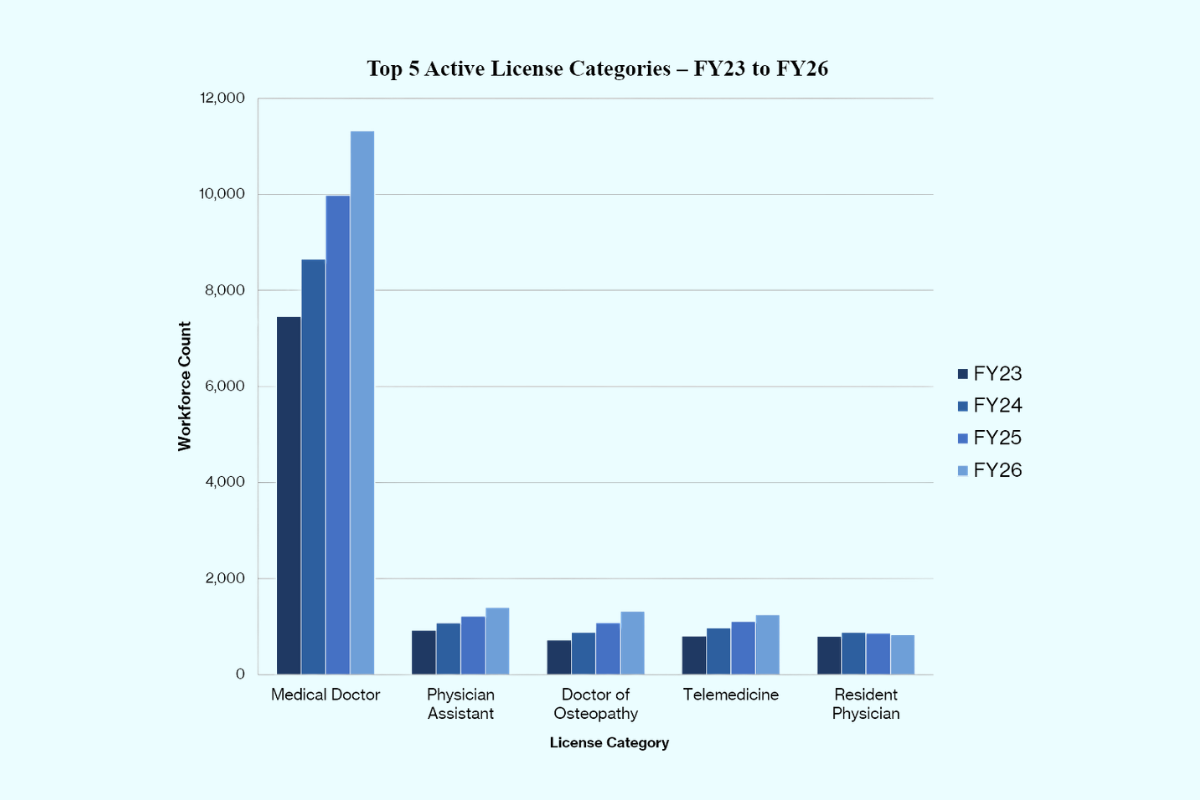
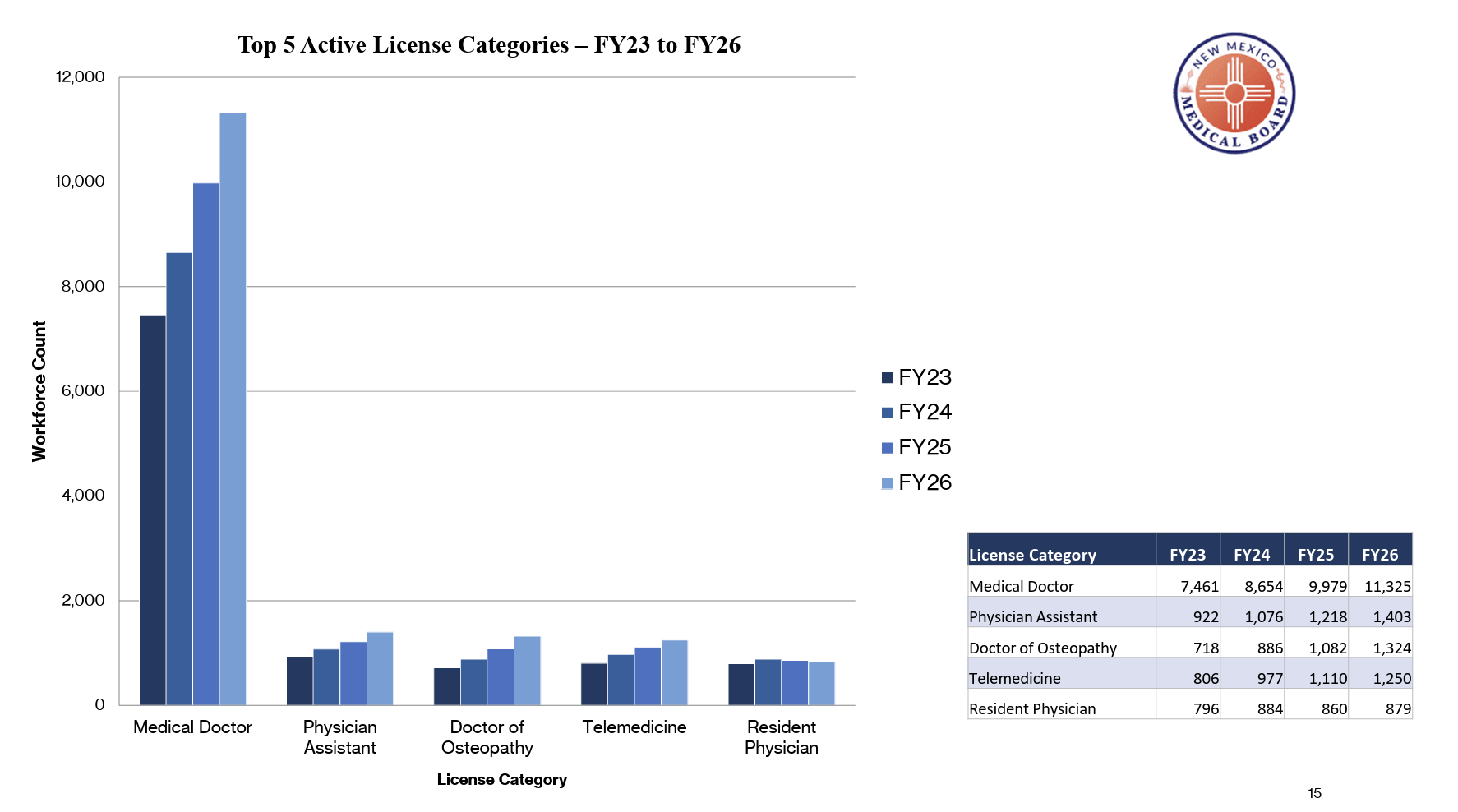
Commentary by Pat Davis, nm.news — During last year’s state legislative session, legislators passed, and the governor signed, a sweeping package of medical licensure and malpractice reform bills to fill what hospital companies and think tanks called “a growing shortage of health care providers.” But new data from the state’s own board responsible for licensing physicians told legislators earlier this month that the state has added more than 3,800 medical doctors over the past four years, up more than 50% since COVID-19 — all before any of those reforms kick in.
Pat Davis is a former police officer and recovering politician working to save local news for New Mexico. After serving two terms as an Albuquerque City Councilor, he became the founder and publisher of nm.news.
In a mostly empty hearing of the Legislative Health and Human Services Committee in Gallup on Aug. 21, the chair of the New Mexico Medical Board told legislators that New Mexico has added over 5,000 providers across every licensed category since July 2022. Specifically, New Mexico has added 3,864 licensed medical doctors (a 52% increase) and 606 Doctors of Osteopathy (DOs) over four years, Board Chair Dr. Karen Carson, MD, told legislators.
New Mexico Medical Board presentation to the New Mexico Legislative Health and Human Services Committee August 21, 2026, Gallup, NM
This new data, not made available to legislators last year, directly contradicts claims by hospital and physician groups who insisted the state was in the midst of a “growing shortage” of providers who would only stay if the state lowered the maximum doctors and hospitals who employ them could be forced to pay in punitive damages designed to punish egregious medical malpractice. While some specialties continue to have shortages measured against national benchmarks, the debate primarily focused on the overall number of providers who would all benefit, regardless of speciality, from lower malpractice rates.
In October 2025, members of the same committee heard from Northwestern University Professor Bernard Black, a national expert on medical staffing, who was mocked by committee Republicans and Senator Martin Hickey, a Democrat and retired doctor who supported capping malpractice payouts, for disputing those claims.
When accounting for inflation, for example, the amount of medical malpractice awards per physician is not increasing, [Northwestern University Professor Bernard Black] argued, and neither is the cost of medical malpractice insurance for certain high-risk specialties…. He also said the number of physicians is not greatly decreasing per capita, except in rural areas, which he said was “not limited to New Mexico. This is a nationwide pattern.”
Black’s findings did not square with what committee Republicans and at least one Democrat said is happening in New Mexico. Sen. Martin Hickey (D-Albuquerque), a retired physician, dismissed out-of-hand any recommendations for New Mexico premised on the idea that the population is growing here or that doctors are not leaving.
“It is not growing. We’re probably shrinking. The number of doctors is not increasing. In fact, we’re the only state to lose doctors, and it’s going down,” he said. “So at the core of what you’re presenting, I’m challenging.”
A recent estimate from the New Mexico Medical Society documented the departure of about 250 physicians in recent years.
At least some legislators were aware at the time that a lack of more accurate data on New Mexico’s physician availability was clouding the debate. State Rep. Elizabeth “Liz” Thomson, a Democrat from Albuquerque who chairs the committee, bemoaned in 2025 the fact that sufficient in-state data was not available before taking up policy changes last year.
State. Rep. “Liz” Thomson, D-ABQ, chairs the Legislative Health & Human Services Committee
“We are kind of shooting in the dark. We do bring in national experts, because we don’t have New Mexico data, and that is just wrong,” Source NM reported at the time.
Instead, legislators and news outlets repeatedly relied on a self-produced report from the New Mexico Medical Society, a lobbying group for medical providers who advocated for capping medical malpractice claims for physicians, who said they had documented the loss of “about 250 doctors” based on an analysis of physicians who billed Medicare and other services. In another report frequently cited during debates, Think New Mexico, a prominent Santa Fe-based think tank advocating for those policy changes, included a section on physician loss that relied compiled by a state working group based on data from 2017-2021 — the middle of the pandemic — but not in the years since.
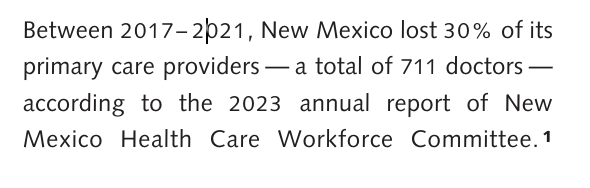
“The main reason behind the shrinking access to health care is a severe and growing shortage of health care providers,” Think New Mexico reported. “Between 2017–2021, New Mexico lost 30% of its primary care providers—a total of 711 doctors— according to the 2023 annual report of New Mexico Health Care Workforce Committee.”
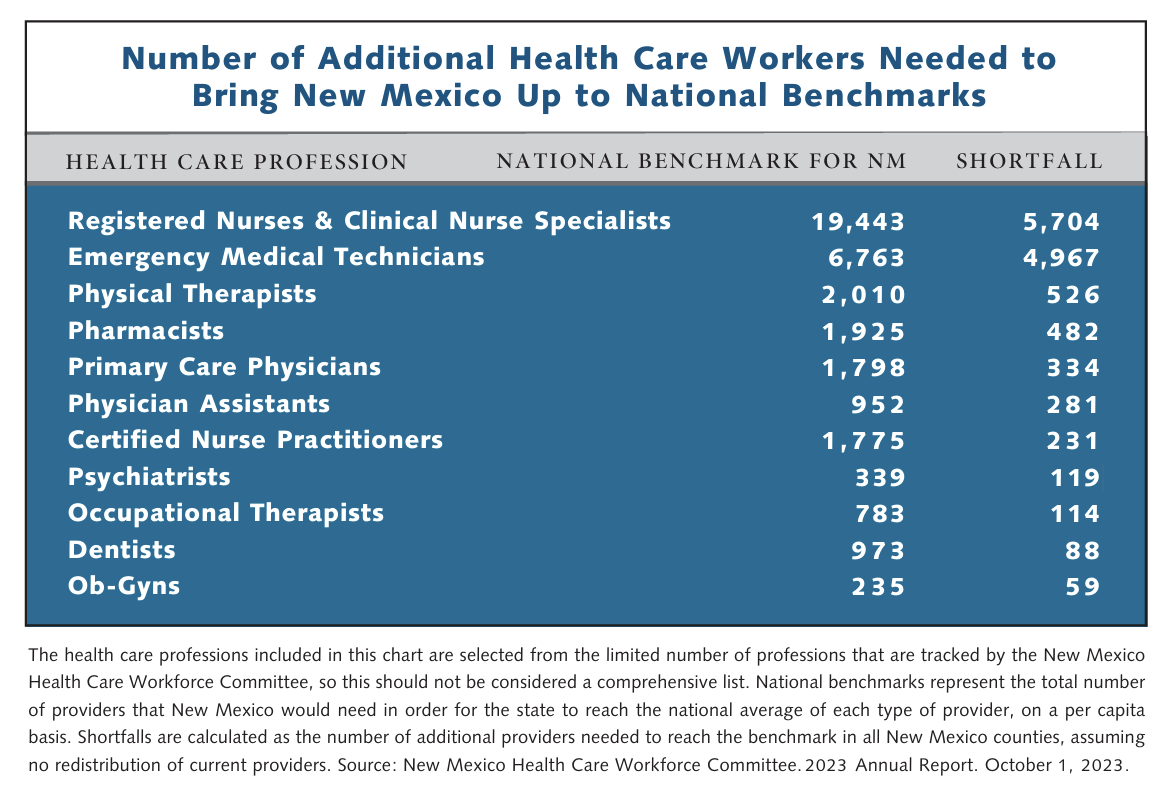
Even when more recent data was available, it was often outdated or unreliable by the time it made it into the public debate. In just one example from the Think New Mexico report, a chart showed that New Mexico needed 952 physician assistants to meet national benchmarks for per capita care in 2023. The Think New Mexico chart said the state was 281 PA’s short, or at 671.
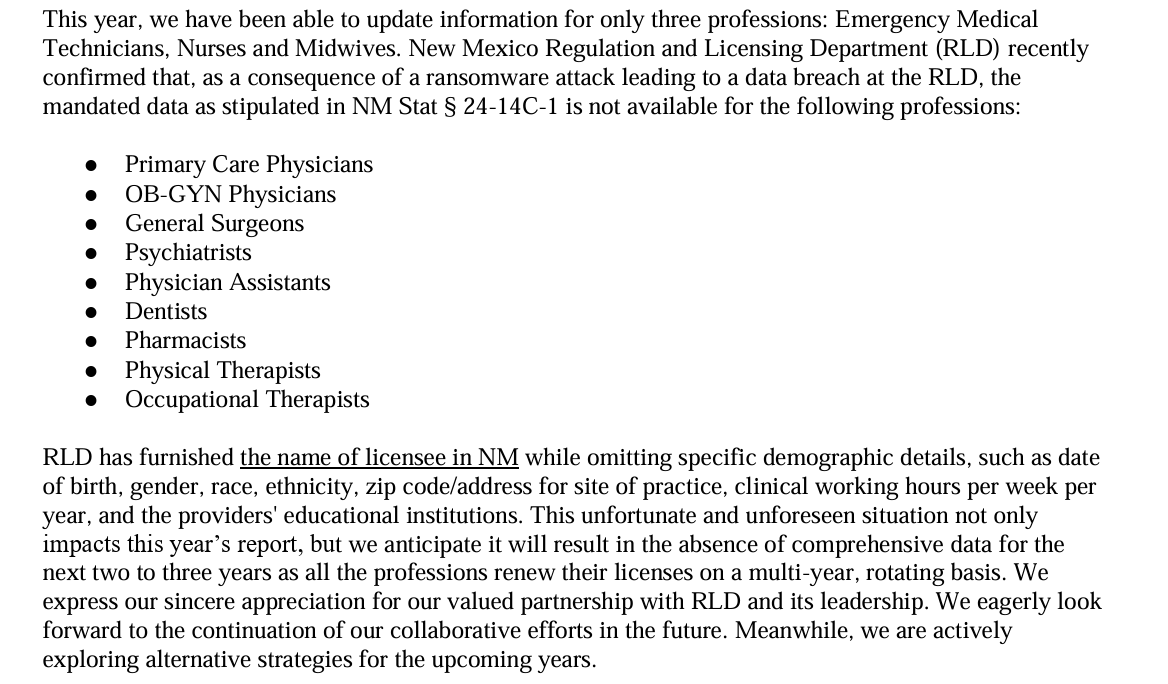
That think tank report and chart, released in September 2024, relied on data from the New Mexico Health Care Workforce Committee, published in October 2023, covering workforce data ending in 2022. But that report had a serious caveat included upfront. “This year, we have been able to update information for only three professions: Emergency Medical Technicians, Nurses and Midwives. New Mexico Regulation and Licensing Department (RLD) recently confirmed that, as a consequence of a ransomware attack leading to a data breach at the RLD, the mandated data as stipulated in NM Stat § 24-14C-1 is not available for the following professions…,” the Committee report warns. “This unfortunate and unforeseen situation not only impacts this year’s report, but we anticipate it will result in the absence of comprehensive data for the next two to three years.”
It goes on to specifically list primary care physicians and physician assistants among professions where data is not available because of the attack. Yet the Think New Mexico report made no mention that the data republished in their chart was not updated or relied upon by their own source.
The New Mexico Medical Board data shared this month shows that the actual number of licensed PA’s had exceeded that standard rising to 1,076 two months before the think tank report was published. When reached by phone Monday, Think New Mexico’s Fred Nathan said the group had shared updated information with the public and legislators after the initial report was published and that state licensing data was misleading because it could include retired and inactive physicians, though the state committee’s data The NMMB report did not distinguish between primary care and other physicians.
The legislature and governor ultimately enacted a package of reforms including caps on punitive damages in malpractice cases and expanded medical licensing compacts with other states.
When the Medical Board appeared before her committee again this month, Thomson asked directly why the board had not provided this data last year.
“They said they don’t want to get political,” Thomson told me when I spoke with her this week. “We need to have good data to make good decisions. When people – purposefully or not purposefully – mislead us with bad data, we end up making bad decisions and New Mexicans get hurt.”