

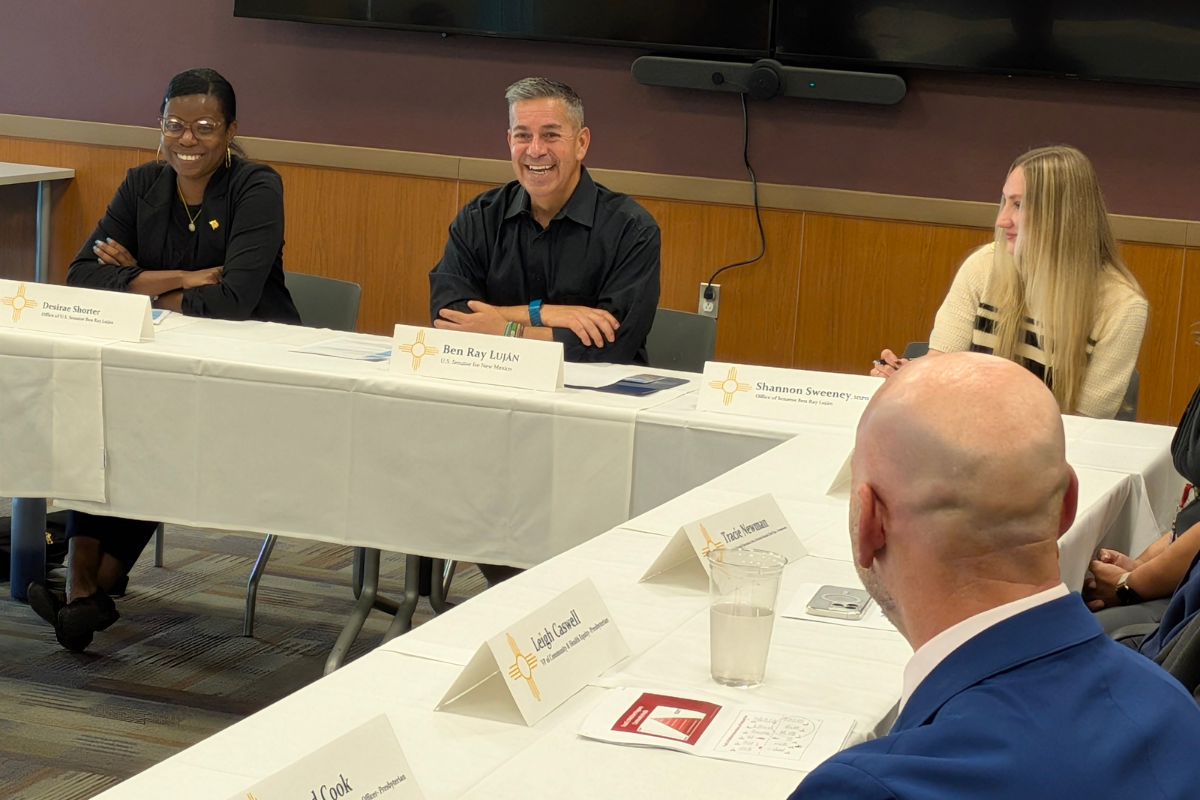
U.S. Sen. Ben Ray Luján, a Democrat from New Mexico, told hospital administrators at Presbyterian Rust Medical Center that Republican-backed federal Medicaid cuts won’t just hurt New Mexicans enrolled in the program — they’ll raise care and insurance costs for everyone else, too.
Presbyterian Delivery System President Chad Aduddell told Luján the nonprofit system — grown from a 1908 tuberculosis sanatorium into New Mexico’s largest integrated health network, with nine hospitals, more than 1,200 employed clinicians and a statewide health plan — is modeling significant financial exposure from the federal budget package’s new Medicaid work requirements, set to take effect in January. Aduddell said New Mexico is more exposed to that requirement, on a per-capita basis, than any other state, and warned Presbyterian will “stop receiving compensation” for care it continues providing to patients who lose coverage. Presbyterian serves roughly one in two New Mexicans, he said.
Presbyterian physicians pressed Luján on federal telehealth policy, noting that pandemic-era waivers allowing broader remote care across geographic boundaries remain temporary rather than permanent law, creating renewal risk for rural patients who depend on them. Luján said he’s working on permanent telehealth reimbursement legislation but acknowledged Congress has not yet acted on making the waivers themselves permanent.
Aduddell and Presbyterian physicians, including Chief Medical Officer Dr. David Arredondo, told Luján that federal graduate medical education funding caps limit how many new residency slots hospitals can create, even as the University of New Mexico prepares to double its medical school class size. Because doctors tend to practice where they complete residencies, Arredondo said New Mexico risks training students who then leave the state for residency spots elsewhere.
Luján also promoted his Stroke Act, which would authorize roughly $25 million annually through fiscal 2032 for stroke research, a national data registry, emergency-response training and public education. The bill has 10 Democratic co-sponsors, including Senate Democratic Leader Chuck Schumer, and is endorsed by the American Heart Association, American Stroke Association and Adult Congenital Heart Association. “Someone dies of a stroke every 3 minutes and 14 seconds in the United States, yet many strokes can be prevented,” said Mark Schoeberl, the American Heart Association’s executive vice president of advocacy.