

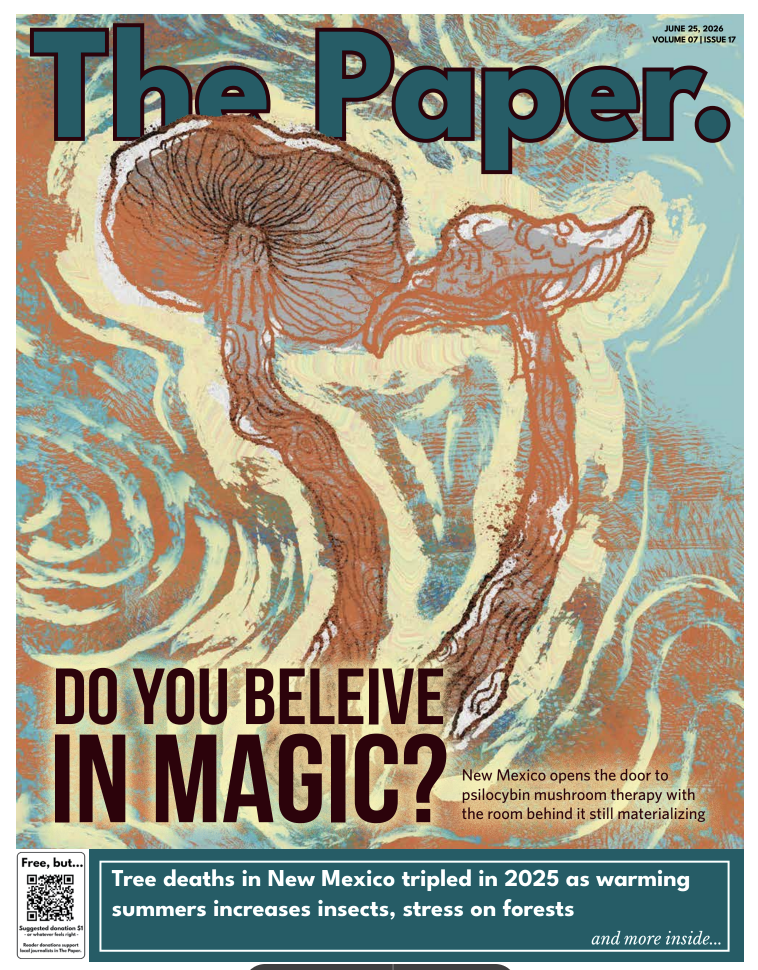
By Skye Rivers, Santa Fe Reporter & The Paper.— Somewhere between medicine and controversy sits a mushroom.
For decades, psilocybin lived in the shadows. The naturally occurring psychedelic compound, found in certain species of fungi, was better known by its street name: magic mushrooms. The mushroom itself is just the organism that produces it. Revered in ancient ceremonies but outlawed by the federal government, the substance’s healing powers have long been dismissed by much of modern medicine.
In 1971, psilocybin was classified as a Schedule I psychedelic under the Controlled Substances Act — noted by the National Library of Medicine in Bethesda, Maryland, alongside heroin — a move that buried its therapeutic potential underground for decades.
However, modern research increasingly indicates psychedelic mushrooms may hold therapeutic value for some of society’s most harrowing conditions, including PostTraumatic Stress Disorder, treatment-resistant depression, addiction and end-of-life anxiety.
As New Mexico prepares to launch the nation’s first wholly medical psilocybin program, officials scurry to respond to any uncovered bases.
The Door Cracks Open in July
On April 7, 2025, Gov. Michelle Lujan Grisham signed Senate Bill 219, pushing New Mexico headlong into the psychedelic era. The state is the third in the country to legalize psilocybin, but the first to do it through the Legislature rather than the ballot box.
The first phase begins next month, with applications open for cultivators and testing laboratories. Those interested in growing psilocybin-carrying mushrooms or testing them can find the applications and updates at nmhealth.org “mid- to late-July,” according to Dr. Dominick Zurlo, director of the Center for Medical Cannabis and Psilocybin.
The process begins for approved treatment facilities later this summer with clinicians and facilitators applications expected in the fall.
The Path to Legality
State senator Jeff Steinborn, D-Dona Ana, is the primary architect of SB 219. He recalls a constituent who reached out years ago to ask what he was going to do about psilocybin. Raised in an abusive environment, she lived with depression no traditional medication could help for years. So she tried microdosing.
Steinborn says the women told him, “Something shifted. It made a difference. It was impactful.”
When SB 219 reached the Senate floor back in March of 2025, Marine veteran Chris Peskuski from Albuquerque spoke on behalf of psilocybin. After serving in Iraq and Afghanistan, he came home with PTSD, an alcoholism problem and a major depressive disorder.
“I was heading downhill pretty rapidly,” he tells SFR. “I didn’t really care about anything, including myself.”
When Peskuski first encountered psilocybin, he noticed something he hadn’t felt in years.
“I would get these waves of emotion and just feel what it was like to feel again,” he says. “I was so numb.”
Peskuski brought his story to the Roundhouse and ended up having a private conversation with Sen. Jay Block, R-Bernalillo/Sandoval, who had been staunchly opposed to the bill. That was all it took for Block to reverse course and invite Peskuski onto the Senate floor the following day to speak in favor of the bill.
About the Law
The Medical Psilocybin Act creates a framework for supervised, state-run psilocybin therapy. Its stated goal is “to allow the beneficial use of psilocybin in a regulated system for alleviating qualified medical conditions.”
At launch, those conditions are: treatment-resistant depression, PTSD, substance-use disorders and end-of-life anxiety. The Department of Health is working on adding more conditions over time.
The first patients will be seen starting in December 2026, DOH officials tell SFR. Patients will not be segregated based on their condition. It will depend on the qualifications of the medical and behavioral health providers and the patients recommended. The initial patients could be from any of the current four qualifying conditions.
Steinborn described the intent plainly: “It’s medicine to help deal with the root cause of what’s causing you these maladies, as opposed to prescriptions that constantly cover up things. If this is medically efficacious and helpful for people, then we need to make it legal.”
Not everyone agrees.
“My community has been home to over 30 ‘pot shops’ since the legalization of marijuana, and our community is not any better for it,” Sen. Larry Scott, R-Hobbs, who voted against the bill, tells SFR. “Similarly, the legalization of these psychedelic mushrooms will only contribute further to the drug abuse epidemic we have been experiencing for quite some time now.”
Home cultivation remains a criminal offense. Personal possession outside a licensed setting is not protected. Sharing or gifting psilocybin, even without money changing hands, is against the law.
How New Mexico’s program differs from other states
Oregon became the first state to legalize psilocybin therapy, with its program launching in 2023. Colorado followed. Both did it through ballot measures with no diagnosis required. Sessions in Oregon run anywhere from $1,200 to $3,000; in Colorado, $1,500 to $3,400.
In New Mexico, patients must be professionally diagnosed with a qualifying condition. New Mexico is the first to use the word “medical” in its psilocybin law, and the first to create a clinician-administered program governed by medical oversight, not consumer access.
The program runs on three licenses: therapists and facilitators, treatment facilities and mycologists/growers who cultivate the medicine itself. Before psilocybin therapy is even considered, a licensed clinician evaluates each patient and screens for anything that might make it unsafe for them.
Every provider must register, demonstrate permitting, and meet training standards handled through an independent third party, with the DOH taking no financial cut. Permits and continued local education will go through the department.
“It will not be a one-size-fits-all training,” Zurlo says. “It all depends on qualifications.”
Steinborn says the landscape for psilocybin will not mirror cannabis.
“There will be no dispensaries. No cards,” he says.
Rick Doblin, founder of Multidisciplinary Association of Psychedelic Studies, says state-level initiatives help ensure psychedelics aren’t administered without therapy and don’t end up as patented prescription drugs only available to the insured.
“By using whole mushrooms in the public domain and requiring preparation sessions, support during the dosing session, and follow-up integration sessions, New Mexico is creating a model for accessibility and public benefit,” Doblin says.
Translating psychedelic medicine into paperwork, licensing procedures, compliance structures and official definitions of what healing looks like rests on the shoulders of Zurlo. He is not new to this kind of tightrope walk. Zurlo helped shape and regulate New Mexico’s Medical Cannabis Program.
“We are moving with care and precision, working through every detail to create a program that is thoughtful, compassionate, and accessible to the people it is intended to serve, particularly those in rural and underserved communities,” Zurlo tells SFR. “Discussions have even included the possibility of mobile medical providers to help bridge access gaps across the state.”
Backing Zurlo is a Medical Psilocybin Advisory Board consisting of nine members and seven working subcommittees drawn from policymakers, clinicians, doctors and community advocates.
The Timeline Is Accelerating
The State Legislature handed DOH a runway through 2027, but it is aiming to land the plane before the end of 2026. Stephanie Dukette, owner of Santa Fe Mountain Mushrooms, says the accelerated schedule caught her off guard.
“They hurried it up,” she says. “I’m building a new facility, and now I’m in the middle of it with nothing I can do about it.”
She’s not opposed to the urgency, just clear-eyed about what it requires.
“The longer you give people to figure things out, it’s not necessarily a good thing. But there’s a lot to do: train the therapists, get the labs up and running, get growers going. And then what? Is there going to be a lab ready? Therapists ready? Is the market ready?” Dukette says. “The patients themselves aren’t a simple variable either. They must complete counseling sessions and clinical screenings before a single session can begin. How do they even get cleared? There’s so much that’s still a question mark right now.”
Peskuski, who sits on the Propagation sub-committee and is training as a facilitator, shares the concern.
“I am cautious that we are moving too quickly. We’re not even close to halfway there as far as I’m concerned,” he says. “I know what happens when I rush dinner. The whole time I’m saying maybe we should slow this down, I am hyper aware that we have a high veteran population in this state and that veterans are committing suicide at alarming rates.”
He says the state is merging traditional medicines used for thousands of years with a therapeutic/medical container he isn’t sure is ready to hold it.
The patients themselves aren’t a simple variable either. They must complete counseling sessions and clinical screenings before a single session can begin.
“How do they even get cleared?” Dukette asked. “There’s so much that’s still a question mark right now.”
Zurlo has a simple answer for why the state is acting so quickly: “The urgency comes from a desire to begin helping people who may benefit from the treatment now, while continuing to refine and adjust the program as it evolves.”
However, unanswered questions remain:
- What will it actually cost to move through this system—the licenses, training, treatment — when many are already using psilocybin on their own terms?
- Will rural communities realistically be able to participate at all?
- Even with the Equity Fund in place, will access still favor those who can afford lengthy treatment programs?
- Who ultimately controls dosing, the patient or the provider?
- As demand grows, who gets prioritized when capacity is limited?
Despite those questions, Peskuski remains hopeful.
“I have no doubt that we’ll treat and help a lot of people,” he says. “Even though I’m a little skeptical of the timeline, I’m still optimistic.”
Meanwhile, whether you see them as medicine or a potential menace, the organism at the center of it all plays by a different set of rules. Mushrooms don’t wait for perfect conditions. They grow out of decay. They don’t wait for laws, they simply emerge where they’re needed.