

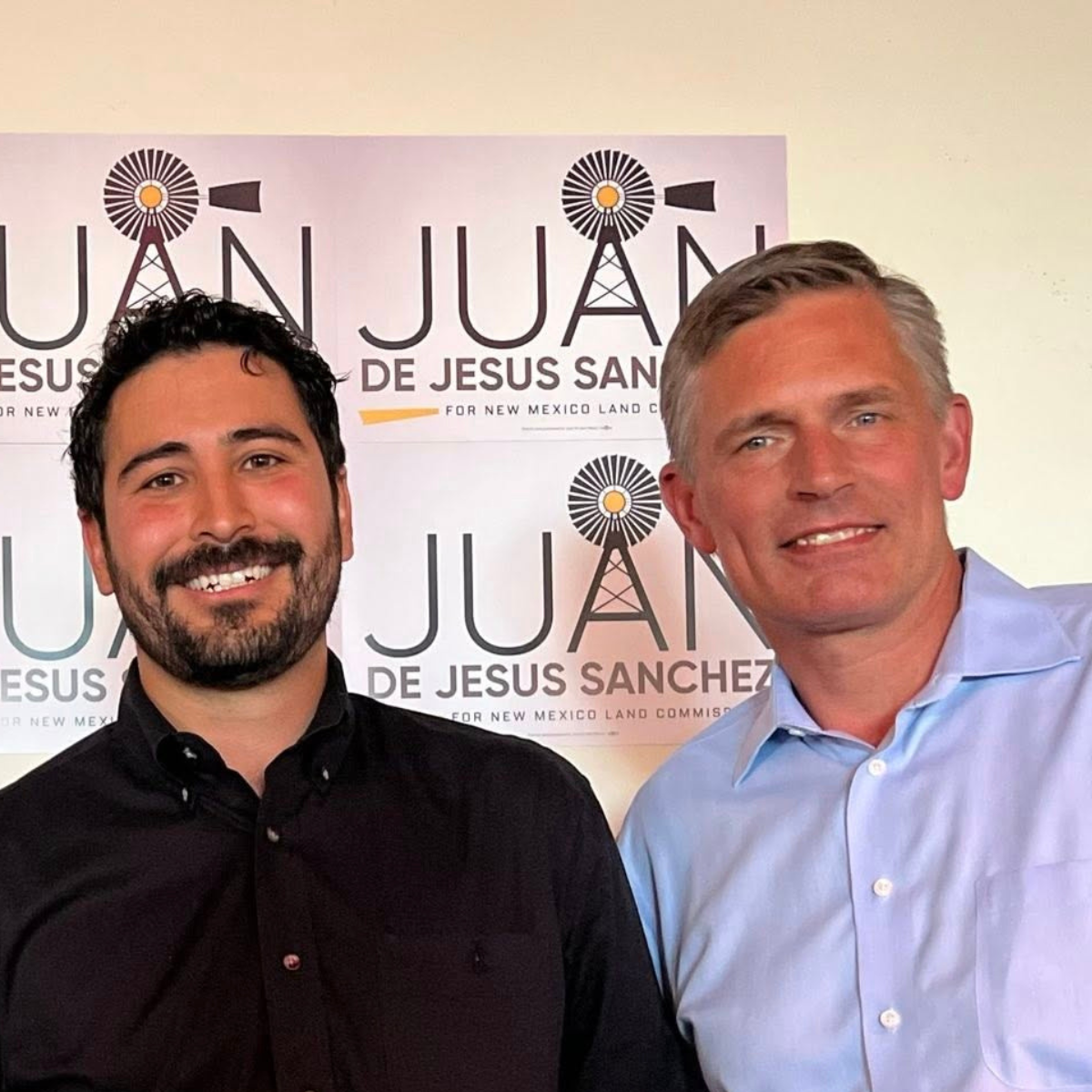
Santa Fe – On a chilly Friday night in late February, a steady line of cars made their way up Santa Fe’s famed Canyon Road. Past the art galleries and James Beard-nominated restaurants, they continued up the canyon where city pavement gives way to a graveled side road and arrived at their destination where samples of elk stew and cocktails warmed them up them before the main event.

New Mexico Politics
Pat Davis is a co-founder and publisher of The Paper. and nm.news. In a former life he served as an Albuquerque City Councilor and led nonprofits working to increase civic engagement.
As the crowd assembled around the living room, two men made their way to the top of a small set of stairs to start their speeches. The first was Juan De Jesus Sanchez III, a first-time candidate who told of his time working as a ranger on public lands and of hunting trips in Corona more rewarding for finding good breakfast burritos than deer. He spoke of his time coming up through the Democratic party, first as an organizer and then running, and winning, as one of its youngest statewide leaders. And he weaved it all together to explain why a Democrat like him is best suited to balance the state’s complicated relationships with oil and gas, clean energy and conservation.

It was a speech the other man could have given himself twenty-five years ago had he chosen to run for land commissioner instead of Congress. But that choice has served him well. Today, Martin Heinrich’s influence over those issues, and more, is much, much bigger.
Heinrich, New Mexico’s senior United States Senator, hosted the event to introduce his endorsed pick for land commissioner to key donors, advocates and allies the senator has cultivated for his own campaigns over more than three decades in New Mexico politics. I was invited to attend and write about the event on the condition that details such as the names of donors and amounts raised were not disclosed before required campaign finance reports were filed.
Heinrich’s endorsement of Sanchez is not particularly surprising given their history. At just 24 years old, Sanchez was elected as a vice chair of the state’s Democratic Party during Deb Haaland’s term as chair. He later worked as Heinrich’s statewide political director and co-chaired Heinrich’s 2024 re-election.
Now, they are embarking on a new journey to elect Sanchez to one of the state’s most powerful and least understood offices (Land Commissioner Stephanie Garcia Richard, a Democrat, is term-limited and cannot run again).
“Senator Heinrich’s endorsement is very impactful for my run for the office of Commissioner of Public Lands,” Sanchez said in an interview after the event. “I plan to bring the experience I’ve gained working for the senator to this office. His record on public lands and these issues is unparalleled. We agree on protecting them—and we certainly agree that we cannot let Donald Trump and his allies sell off our public lands and resources to the highest bidder.”
The impact of Heinrich’s endorsement cannot be overstated in a contested primary election like this one where Sanchez faces well-known State Rep. Matthew McQueen of Galisteo who has spent years building his own conservation resume in the state legislature. It’s a race most high-ranking politicians in the state would, and have, shied away from; but not Martin Heinrich.
For Sanchez, the impact of a Heinrcih endorsement shows. Access to a national-level policy and fundraising machine isn’t in the playbook for most first-time candidates. Campaign finance reports filed in early April show that McQueen has raised $326,963 ahead of the June primary, including a little over $115,000 he brought over from previous campaign accounts. Sanchez trails with just $169,020. Going into the final 90 days of the campaign, McQueen enjoys a $76,000 cash advantage, which means more money for ads. A third candidate, Jonas Moya, has raised $33,356.

Nonetheless, Heinrich’s help is making up for lost time. Sanchez featured Heinrich’s endorsement prominently at the party’s state convention earlier this year where he bested McQueen by earning more than half of the delegate votes in their race. And Sanchez’s finance reports are peppered with donations from out-of-state donors who have also donated to Heinrich’s campaigns over the years. Sanchez’s campaign confirmed that the Santa Fe event in February, and another hosted by Heinrich a few weeks earlier in Washington, D.C., were his top two fundraising days of the campaign to date, and there is still time for more.
“First endorser”
Martin Heinrich’s practice of endorsing candidates in local races is so well known in New Mexico that political blogger Joe Monahan has dubbed him the “First Endorser.” Where most elected officials at his level shy away from nasty inter-party campaigns, Heinrich has made it a key part of his political persona. Over the past 10 years, Heinrich has endorsed at least 120 local candidates, and he does so early. (Full disclosure: Heinrich was one of the first endorsers for my campaign in 2015 to Albuquerque’s City Council in the district he once represented and again in 2019 for re-election).
In 2025’s local elections last November, Heinrich weighed into more than dozen local elections from school boards to city mayors and councilors statewide, including in Santa Fe where he endorsed Michael Garcia for mayor in an eight-way mostly Democrat-on-Democrat contest. Garcia ultimately won after a ranked-choice voting tally.

Heinrich’s endorsement can often come with campaign help, too. Already in 2026, his Lobo Leadership PAC has contributed more than $6,000 to candidates he endorsed, including $2,000 to Sanchez.
To Heinrich, endorsing a candidate like Sanchez in the land commissioner race makes sense on multiple levels. “I think he’ll be a really good land commissioner, and there aren’t a lot of checks and balances on that position,” he said in an interview after the event in Santa Fe. “So having somebody in there with a strong set of morals, it’s really important. Having somebody who has a similar conservation ethic to me is important to me. And finally, because I think he’s the kind of candidate that can help us turn the Democratic Party back into a majority party, not just in New Mexico, but nationwide.”
As an Albuquerque City Councilor in the mid-2000’s, Heinrich co-sponsored progressive legislation raising the city’s minimum wage and enacting rebates for low-flow toilets; in Congress, he has co-sponsored “Medicare for All” legislation with Senators Bernie Sanders (D-VT) and Elizabeth Warren (D-MA). But he has also forged his own path building coalitions across the aisle to protect large swaths of public lands and modernize our nation’s aging electric grids. In other words, his politics are a mix of progressive and pragmatic.
While it’s true that many of the local candidates he endorses are from the progressive end of the spectrum, Heinrich dismisses criticisms that his endorsements are about trying to make the party more progressive. “[Bloggers] sometimes pigeon hole my endorsements,” he told me. “My endorsements are not about a policy prescription so much as it’s about building the farm team of the future, making sure that the party continues to be a majority party. And I am a believer that when we have gone astray as Democrats, it’s any time we talk down to any group, and our language has alienated people in recent election cycles.”
That type of pragmatic progressivism has helped deliver results, he says. Heinrich draws a direct line between his “farm team” program and the makeup of the Democratic caucus in the state legislature in place to pass a repeal of what he describes as the state’s “outdated abortion ban” before a Republican-led effort to overturn Roe vs. Wade was successful, and passage of universal early childhood education which he sees as transformative for education policy long term.
“Those are two real world examples of things that I saw that were structurally challenging for the state,” Heinrich said. “If I just sit in my lane and try to be a few points more popular, versus spending my political capital on things that I think create dividends for the state as a whole, I would rather do the latter.”