

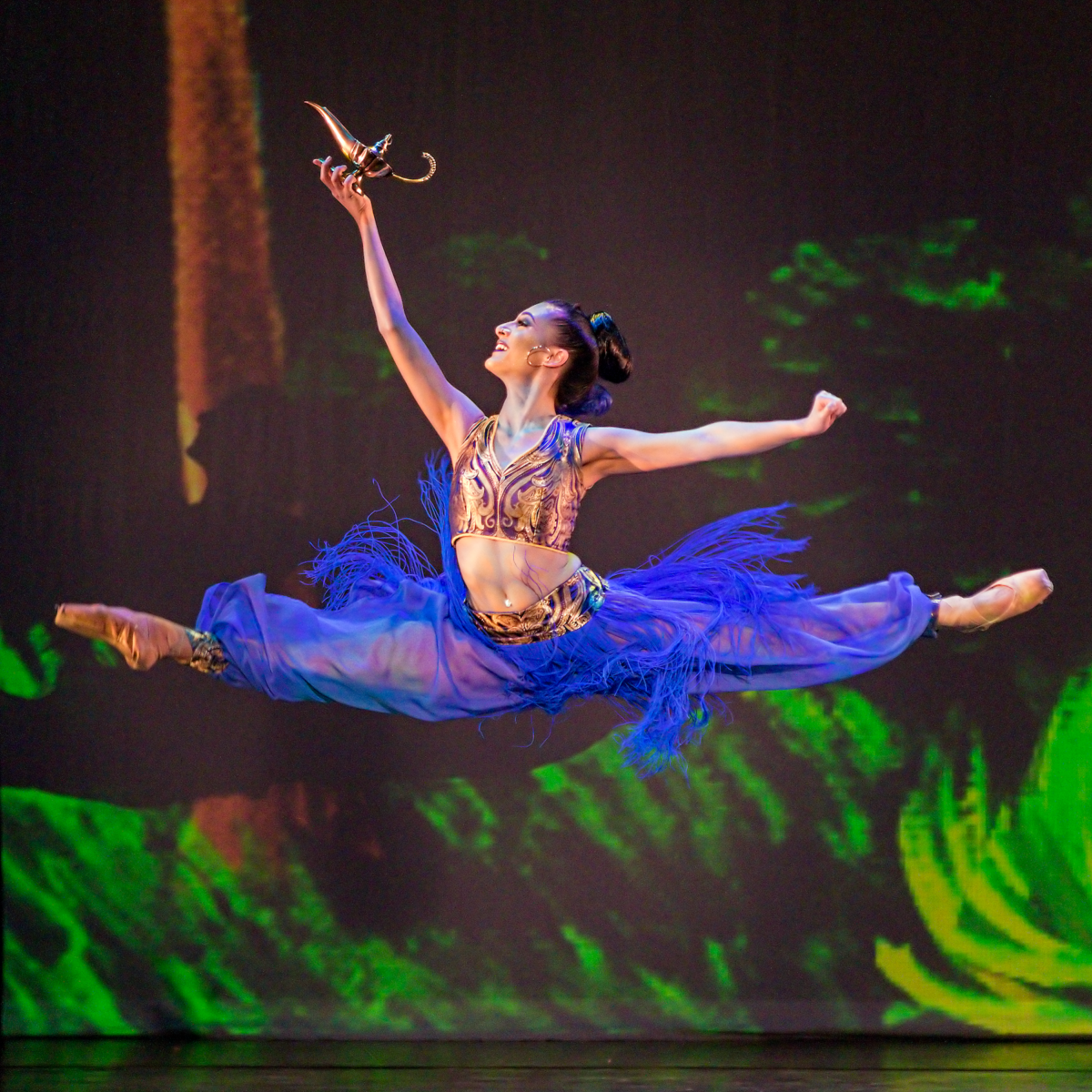
By Sara Atencio-Gonzales, The Paper — A familiar tale filled with magic, adventure and romance will return to the stage this month as the New Mexico Ballet Company and the New Mexico Philharmonic collaborate once again for a fully staged ballet performance at Popejoy Hall.
The two organizations will present Aladdin and the Magic Lamp on Saturday, March 28 at 6 p.m. The production combines live orchestral music with choreography that brings the classic story from One Thousand and One Nights to life.
The ballet is choreographed by Kelly Ruggiero, artistic director of the New Mexico Ballet Company, and will be performed to music played live by the orchestra under the direction of Alejandro Gómez Guillén.
While many audiences know the story through modern adaptations, Ruggiero explains that this version draws inspiration from the original source material.
“We have brought it back, but in a different way,” says Ruggiero. “We have actually taken it back to the original story, which I don’t think a lot of people are familiar with, after Disney’s interpretation of it. It’s actually quite a different story.”
The company previously staged the ballet in 2018, but Ruggiero explains that this year’s production places a stronger emphasis on details found in the traditional tale.
Kira Peterson as The Sorcerer (Photo courtesy Cooper Rain Photography)
One of those elements appears in the Cave of Wonders scene, where Aladdin collects treasures before approaching the Sultan. “In the original story, Aladdin, when he enters the cave, gathers gemstones, and he uses these gemstones to present to the Sultan to try and ask for the princess’s hand in marriage,” says Ruggiero. “Gemstones were not originally a part of our 2018 production. So I’ve had a lot of fun working with that.”
Ruggiero researched rare stones from around the world and incorporated them into the ballet’s staging and choreography.
“I just decided to look up some of the world’s rarest gemstones,” says Ruggiero. “I chose alexandrite, black opal, tanzanite and painite and decided to integrate those into the Cave of Wonders.”
Another feature that audiences may notice is the presence of two magical characters rather than one. “In the original story, there is a ring genie and a lamp genie,” says Ruggiero. “That’s been a fun process to have two genies and have those two genies interact with one another.”
(Photo courtesy Cooper Rain Photography)
The performance also highlights the collaboration between dancers and live musicians, something Ruggiero said brings a unique energy to the stage.
“I’ve performed in various companies where we haven’t had live music, and it’s just a completely different experience,” says Ruggiero. “When you have the live orchestra in front of you, the tones and the sounds are much different.”
Dancers typically rehearse with recorded music, which means the transition to a live orchestra requires flexibility.
“In rehearsals, we use recordings of pieces of compositions, and it is always predictable,” says Ruggiero. “When you then present yourself with live music, it’s not the same orchestra performing that same exact piece, and rhythms can kind of fluctuate.”
Because of those subtle differences, dancers must rely on listening closely to the orchestra during the performance. “There’s a lot more adapting on the dancer’s side and really having to use their ears to follow the music,” says Ruggiero.
For the musicians performing in the orchestra pit, playing for ballet presents a different experience than a traditional concert.
Marian Tanau, president and CEO of the New Mexico Philharmonic, said the orchestra shifts its focus toward supporting the story onstage. “For our traditional concerts, we’re usually on stage, and we are the center of attraction,” says Tanau. “And with the ballet, we are there to support the story by playing the music.”
Natalie Harrison and Madyson Kettler (Photo courtesy Cooper Rain Photography)
Instead of performing in front of the audience, the musicians accompany the dancers from the orchestra pit while the visual storytelling unfolds on stage.
“That focus is on the ballerinas and ballet dancers, male ballet dancers, who will dance on the stage,” says Tanau.
This year’s production features music by Russian composer Nikolai Rimsky-Korsakov, including selections from the symphonic work Scheherazade, which is also inspired by Middle Eastern folklore. “The piece itself is very beautiful,” says Tanau. “The musicians love to play it, and it’s a story piece. In other words, the music has a story to tell as it is.”
Because the music already carries a narrative quality, Tanau said it pairs naturally with a ballet interpretation of the Aladdin story. “It was just nice to fit into the story of Aladdin and The Magic Lamp,” says Tanau.
The partnership between the ballet company and the Philharmonic has developed over many years through joint performances and collaborations.
“When I joined the orchestra here and I met the people from the New Mexico Ballet Company, I realized that they had a great team and great set of dancers,” says Tanau.
That relationship eventually expanded into additional productions beyond the annual holiday ballet. “We diversified the offering to our audiences,” says Tanau. “It’s just a good give-and-take and a great partnership that we have with them.”
For audiences, the combination of live music and dance offers a performance that appeals to both ballet lovers and classical music fans. “It brings a different kind of audience to not just the people that want to see the ballet, but the people that are also music-oriented,” says Ruggiero.
Tanau explains that the show can also serve as a welcoming introduction for those who may not typically attend ballet or orchestral performances.
“The music is very accessible and beautiful,” says Tanau. “The story of Aladdin is great, and it’s easy to tell through dancing.”
Ruggiero believes the recognizable storyline also helps make the performance accessible to first-time ballet audiences. “Aladdin and The Magic Lamp is a much more contemporary take on ballet,” says Ruggiero. “It’s one that maybe will be easier for them to just relate to.”
Ultimately, both artists hope audiences will walk away moved by the blend of music, movement and storytelling.“I just love seeing the reactions from audience members, especially young kids,” says Ruggiero. “Sometimes this is how they start entering into dance classes and start taking that as a career path, because they’re inspired from what they see in the theater.”
Tanau hopes audiences notice both the athletic skill of the dancers and the emotional power of the music. “I’d like them to admire the way the dancers can turn and pirouette and dance and jump and hold each other,” says Tanau. “While at the same time, I’d like them to notice and get emotional because of the music that our orchestra is performing.”
Aladdin and the Magic Lamp will be performed March 28 at Popejoy Hall. Tickets are available through the UNM Tickets website (unmtickets.com).